
During my recent visit back home to India, the convenience and ubiquity of instant delivery apps left me astounded. One night, my husband developed a cough, and within moments of considering a trip to the chemist the next morning, my father had already ordered Vicks Vaporub via BlinkIt, promising its arrival in just 10 minutes. He ordered just one item at 10pm, and it would be assigned, ready, picked up, and delivered in 10 minutes. Incredible!
This instance wasn’t just a one-off; it was reflective of a broader, deeply ingrained cultural embrace of these services, from food delivery on Swiggy without minimum order constraints to using the Porter app for business logistics. As a product manager, my radar is always up for understanding not just what makes a product tick, but also why certain technologies become almost viral in their adoption. And India, in 2024, offers a textbook case of market adoption magic.
With a projected revenue of US$3,349.00m (approximately ₹27,429.8 million) in 2024 and a compound annual growth rate (CAGR 2024-2028) of 27.42%, leading to a market volume of US$8,828.00m (around ₹72,269.6 million) by 2028, the quick commerce sector is reshaping how Indians shop, dine, and do business. This growth is not just numbers on a chart; it’s visible on the streets of India’s bustling cities, in the hands of its people, and in the fabric of daily life.
India’s journey is a fascinating narrative of how technology can redefine market landscapes in relatively short periods. The rapid rise of instant delivery services, from food and groceries to medicines, in a country that was predominantly cash-reliant less than a decade ago, underscores a significant cultural and economic shift. It’s the harnessing of the unorganized labor sector, alongside engaging both small business owners and consumers in a symbiotic digital ecosystem, that makes this case study particularly rich for analysis. As Malcolm Gladwell said in his book Outliers, “Success is not a random act. It arises out of a predictable and powerful set of circumstances and opportunities.”
Personal Observations: A Culture of Convenience
In India, the reliance on personal help for tasks like cooking and cleaning is common. Instant delivery apps have seamlessly transitioned this dependence into the digital age, making it easier than ever to order food or send packages with a few taps on a smartphone. This cultural readiness for convenience services has created a fertile ground for the booming growth of apps like Swiggy, BlinkIt, and Porter by extending the demand for these services from dedicated hired employees like cooks, drivers, and ‘errandpersons’ to a distributed network of persons who can perform tasks based on availability and willingness.
The Gig Economy: A Win-Win for Supply and Demand
The success of these apps isn’t just about demand. India’s vast unorganized economy, ripe with individuals looking for flexible earning opportunities, has created a robust supply side. Similar to how platforms like Uber and Airbnb utilize underutilized resources (time and space, respectively), these delivery apps tap into the readily available time and transportation means of millions. This arrangement not only provides flexible employment but also ensures that services are swift and efficient.
Technological Backbone: Digital and Physical Infrastructure
Critical to this rapid adoption is India’s digital revolution. The widespread availability of affordable smartphones and internet access has made it easier for consumers to embrace these apps. Simultaneously, advancements in payment technologies and online financial services have streamlined transactions, making the process hassle-free for both users and providers.
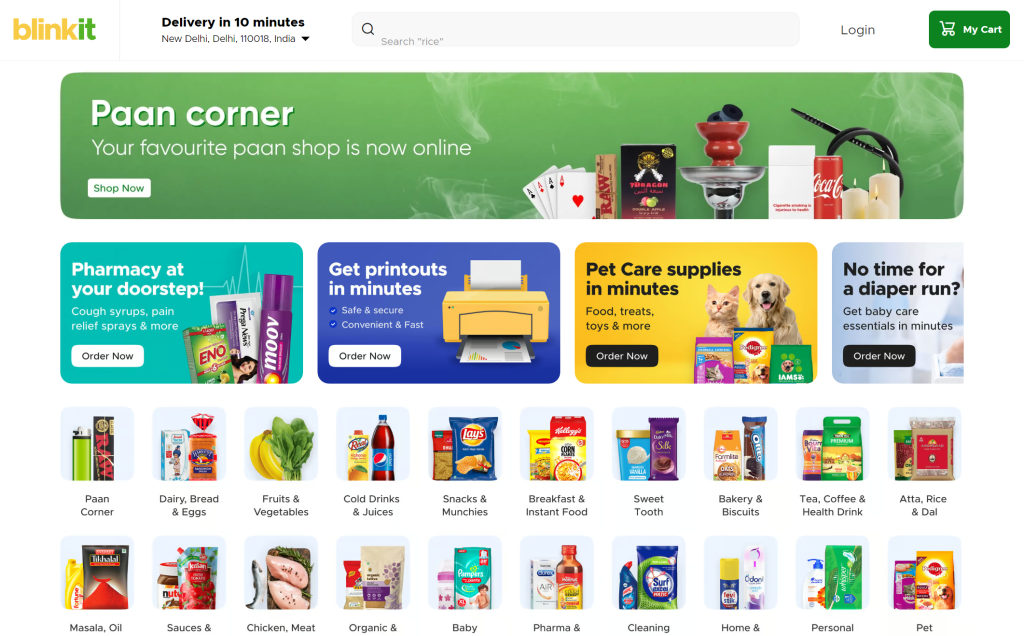
BlinkIt showcases its inventory as a variety of use cases and shopping categories
PLG (Product-Led Growth) in Action
Propelled by these significant infrastructural advances, instant delivery apps in India have masterfully harnessed product-led growth (PLG) strategies to drive remarkable value-based expansion. At the heart of their success is the immediate value addition to users’ lives, offering not just convenience but an integrated experience that keeps pace with the cultural and daily rhythms of Indian society. Special promotions, discounts, and curated inventories for holidays and festivals further personalize the experience, making each app interaction feel tailored and timely.
These platforms have brilliantly capitalized on network effects, where each new user, merchant, and delivery partner adds incremental value to the ecosystem. This burgeoning network doesn’t just enhance the service’s reliability and speed; it fuels the growth flywheel, creating a self-sustaining cycle of engagement and expansion. The more the network grows, the more attractive the platform becomes to new users, thereby accelerating growth even further.
The return rate of users is a testament to the enduring value these apps offer. By marrying convenience with affordability, they’ve created a compelling proposition that keeps users coming back. It’s a clear indication that when products genuinely meet user needs and expectations, growth is not just accelerated but also sustainable. This PLG approach, focusing on the product itself as the primary driver of user acquisition, retention, and expansion, has positioned instant delivery apps as indispensable tools in the daily lives of millions across India.
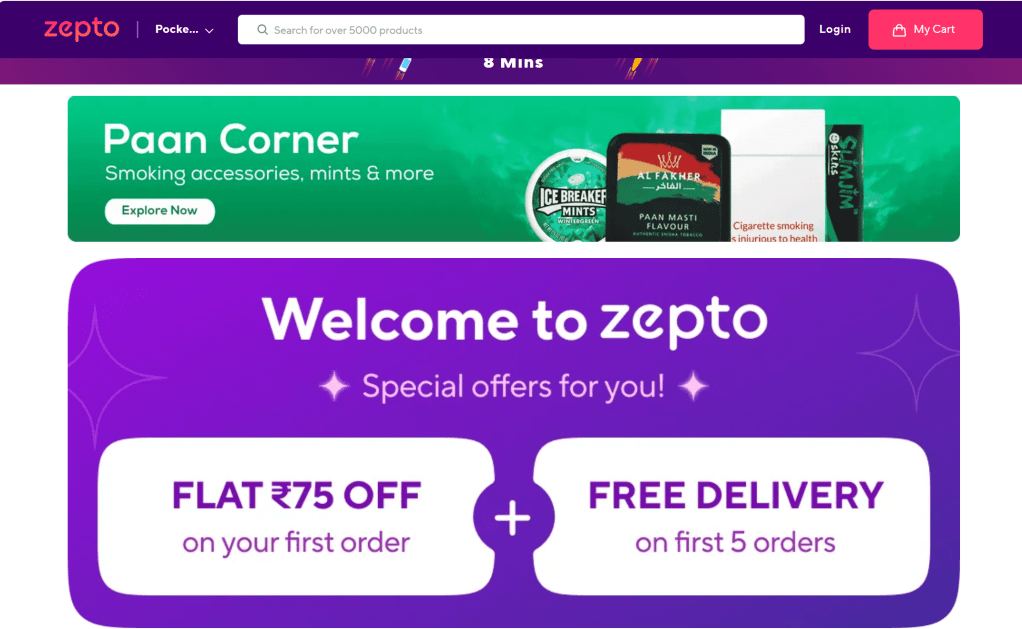
Zepto takes advantage of a first-time discount to lower the barrier of entry for the user, and goes further to give free delivery on the first 5 orders in hopes that users will build a habit of using Zepto by the fifth order.
The Economic Impact: Growth and Opportunities
The numbers speak volumes about the impact of instant delivery services on the Indian economy. The financial narratives of companies like BlinkIt, with a revenue of almost 26.2 billion Indian rupees (around $335.7 million) in the financial year 2022, and Swiggy, boasting over 57 billion Indian rupees (approximately $730.4 million) in revenue, underscore the economic significance of instant delivery services. These figures, converted to US dollars for global context, not only highlight the sector’s profitability but also its role in driving forward India’s digital economy. The quick commerce market, expected to grow 10-15x to become $5 billion by 2025, is a testament to the transformative power of these platforms.
Urbanization and Market Expansion
The burgeoning presence of instant delivery apps in India’s urban sprawl, spanning both tier 1 megacities and rapidly growing tier 2 cities, underscores the robust scalability and adaptability of the instant delivery model. In bustling metros like Mumbai, Delhi, and Bangalore, these apps have become a staple, seamlessly integrating into the fabric of daily urban life by offering everything from lightning-fast food delivery to urgent grocery runs. However, their strategic expansion into tier 2 cities, such as Jaipur, Coimbatore, and Lucknow, is where the real story of market penetration unfolds.
This expansion taps into a burgeoning demand in these smaller cities, where digital literacy is rising, and the middle-class consumer base is expanding. For instance, apps like Swiggy and Zomato have made significant inroads by diversifying their services to cater to the unique needs and preferences of these areas, offering local delicacies and regional specialties alongside their standard fare. Similarly, BlinkIt (formerly Grofers) and Dunzo have extended their logistics networks to ensure that the same level of instant gratification experienced in larger cities is replicated, delivering everything from stationery to pharmaceuticals within minutes.
Moreover, the growth in tier 2 cities has been bolstered by partnerships with local merchants and businesses, fostering an ecosystem that benefits all stakeholders. These collaborations not only expand the variety and reach of the apps but also empower small businesses to digitize their operations and tap into a wider customer base. For example, Porter’s logistics solutions have enabled local businesses to streamline their supply chains, offering point-to-point delivery services that were previously beyond their reach.
As these apps consolidate their presence across India’s urban landscape, they’re not just bridging the gap between traditional and digital marketplaces; they’re crafting a new narrative of convenience, efficiency, and economic opportunity. The adaptability of their services to meet the distinct needs of tier 2 cities exemplifies how technology can drive inclusive growth, making the benefits of the digital economy accessible to a broader segment of the Indian population.
Future Prospects: Beyond Convenience
As we peer into the future, the role of instant delivery apps in India extends far beyond mere convenience. These platforms stand at the cusp of revolutionizing the country’s economic fabric, but this transformative journey invites a nuanced examination of both its impacts and the lessons it offers to the global stage.
Firstly, the explosive growth of these apps raises critical questions about market dynamics. While they undeniably contribute to economic expansion, it’s essential to discern whether this growth introduces new value or merely redistributes existing market shares. Similar to how Airbnb disrupted the traditional hotel industry and Uber reshaped taxi services, instant delivery apps could potentially impact local retailers and traditional markets. Are small shops losing out as consumers flock to the convenience of app-based purchases, or is the digital economy expanding the overall market pie by introducing efficiencies and reaching untapped consumers? This balancing act between innovation and market disruption forms a crucial narrative in evaluating the broader economic implications.
Secondly, the Indian success story offers rich insights for Western markets, where the landscape differs markedly in terms of labor costs, organizational economy scale, and consumer habits. The willingness of Western consumers to pay for convenience, as seen in the tentative steps taken by Uber and DoorDash into grocery and item delivery, presents an intriguing area for exploration. With Southeast Asia already embracing similar models through platforms like Grab, there’s a compelling case for studying how India’s model could inform or adapt to Western contexts. This exploration could reveal valuable thresholds for consumer willingness to pay and potential strategies for integrating such services more deeply into daily life.
Lastly, the advent of emerging technologies like drone and autonomous vehicle deliveries beckons a future where the mechanics of delivery could undergo profound changes. This technological shift prompts a critical assessment of the role of human labor in the delivery ecosystem. Will we witness a replacement of low-skilled delivery jobs with automated solutions, or will there be a geographical divide in service delivery methodologies—man versus machine—across different parts of the world? The trajectory of instant delivery services in India, juxtaposed with technological advancements, could provide a blueprint for the global economy, navigating the delicate balance between innovation, employment, and service accessibility.
As we contemplate the future of the instant delivery economy, these considerations underscore the importance of strategic growth that harmonizes technological progress with socio-economic inclusivity. The Indian experience, rich with lessons and cautionary tales, not only illuminates the path forward for emerging markets but also offers a mirror for the global community pondering the integration of such services into the fabric of everyday life.
Blog written by my GPT BlogWriterPro using my own insights, primary customer research, and market research with the following resources. The images were created using Microsoft Designer and product screenshots taken from the product website.
Resources for data cited:
(1) Porter | Mini trucks & bikes for delivery | Packers & Movers | Book and …. https://porter.in/. (2) Same Day Courier Service in Tier 1 & 2 cities of India – Porter.in. https://porter.in/services/same-day-courier. (3) Most Reliable Delivery Services with Doorstep Delivery – Porter.in. https://porter.in/services/delivery. (4) Dunzo – 19 Min Grocery Home Delivery in Bangalore | Order Vegetables …. https://www.dunzo.com/. (5) 5 Best Fast Same Day Delivery & Courier Apps in India – Smartprix. https://www.smartprix.com/bytes/5-best-fast-same-day-delivery-courier-apps-in-india/. (6) Everything delivered in minutes | Blinkit. https://blinkit.com/. (7) From Zepto to Blinkit, a look at apps that offer 10 minute delivery …. https://indianexpress.com/article/technology/social/zomato-instant-zepto-blinkit-apps-that-offer-10-15-minute-delivery-service-in-india-7831106/. (8) Delivery Areas – Zepto. https://www.zeptonow.com/delivery-areas. (9) Uber Connect package delivery service launched in India … – India Today. https://www.indiatoday.in/technology/news/story/uber-connect-package-delivery-service-launched-in-india-here-is-how-to-use-the-services-1677853-2020-05-14. (10) Uber Newsroom. https://www.uber.com/en-IN/newsroom/uber-launches-uber-connect-a-new-package-delivery-service-to-connect-with-family-and-friends/. (11) Borzo India (Previously WeFast) — Reliable Same-Day Delivery Service …. https://borzodelivery.com/in. (12) Wefast – Courier Delivery App APK (Android App) – Free Download – APKCombo. https://apkcombo.com/wefast-courier-delivery-app/com.delivery.india.client. (13) Top 10 courier Delivery apps in India | Review & Services – PaisaWapas Blog. https://www.paisawapas.com/blog/top-10-courier-delivery-apps-in-india/. (14) Swiggy launches 15-30 minute grocery deliveries, expands … – Moneycontrol. https://www.moneycontrol.com/news/business/swiggy-launches-15-30-minute-grocery-deliveries-expands-instamart-to-5-more-cities-in-india-7311761.html. (15) Order Food Online from India’s Best Food Delivery Service | Swiggy. https://www.swiggy.com/. (16) Swiggy, Zomato and other apps delivering groceries in India: Everything …. https://www.indiatoday.in/technology/features/story/swiggy-zomato-and-other-apps-delivering-groceries-in-india-everything-you-need-to-know-1666703-2020-04-14. (17) The delivery apps reshaping life in India’s megacities. https://www.technologyreview.com/2022/06/21/1053884/india-megacities-delivery-apps/. (18) Grocery delivered in 10mins | Zepto. https://www.zeptonow.com/. (19) Best Instant Grocery Delivery Apps in India 2024: Blinkit, Zepto …. https://www.mysmartprice.com/gear/best-grocery-delivery-apps-in-india/. (20) Check all the cities we deliver to – Zomato. https://www.zomato.com/delivery-cities. (21) Zomato launched intercity delivery services for THESE cities: here’s …. https://www.dnaindia.com/personal-finance/report-zomato-launched-intercity-delivery-services-for-these-cities-here-s-how-to-avail-2981368. (22) Uber Connect Home-to-Home Package Delivery Service Launched in India …. https://www.gadgets360.com/apps/news/uber-connect-launched-four-cities-india-delivery-of-packages-during-lockdown-2227994. (23) Quick Commerce – India | Statista Market Forecast. https://www.statista.com/outlook/dmo/online-food-delivery/grocery-delivery/quick-commerce/india. (24) Quick commerce shakes up grocery delivery – The New Indian Express. https://www.newindianexpress.com/business/2022/jan/02/quick-commerce-shakes-up-grocery-delivery-2402072.html. (25) India’s 10-15 minute delivery market to reach $5.5 billion in 3 yrs: Report. https://www.business-standard.com/article/markets/india-s-10-15-minute-delivery-market-to-reach-5-5-billion-in-3-yrs-report-122030300382_1.html. (26) India Online Food Delivery Market Size, Report 2024-32 – IMARC Group. https://www.imarcgroup.com/india-online-food-delivery-market.





 Hassan and Manya
Leave a comment